
The small problem I wanted to solve
You copy a link. Then a sentence. Then something else. The thing you wanted a moment ago has disappeared from the clipboard. I wanted a small Windows app that made getting it back feel natural.
That became Vstavka: a visual clipboard history that opens with Ctrl + Shift + V. Text, links, images, colors, and file paths appear as cards in a ribbon at the bottom of the screen. Find the right item, select it, and get back to what you were doing.
I described the product I wanted to GPT-6 Astra. I gave feedback on the interface, behavior, and finish. I did not write a single line of the application code myself.
Meet Vstavka
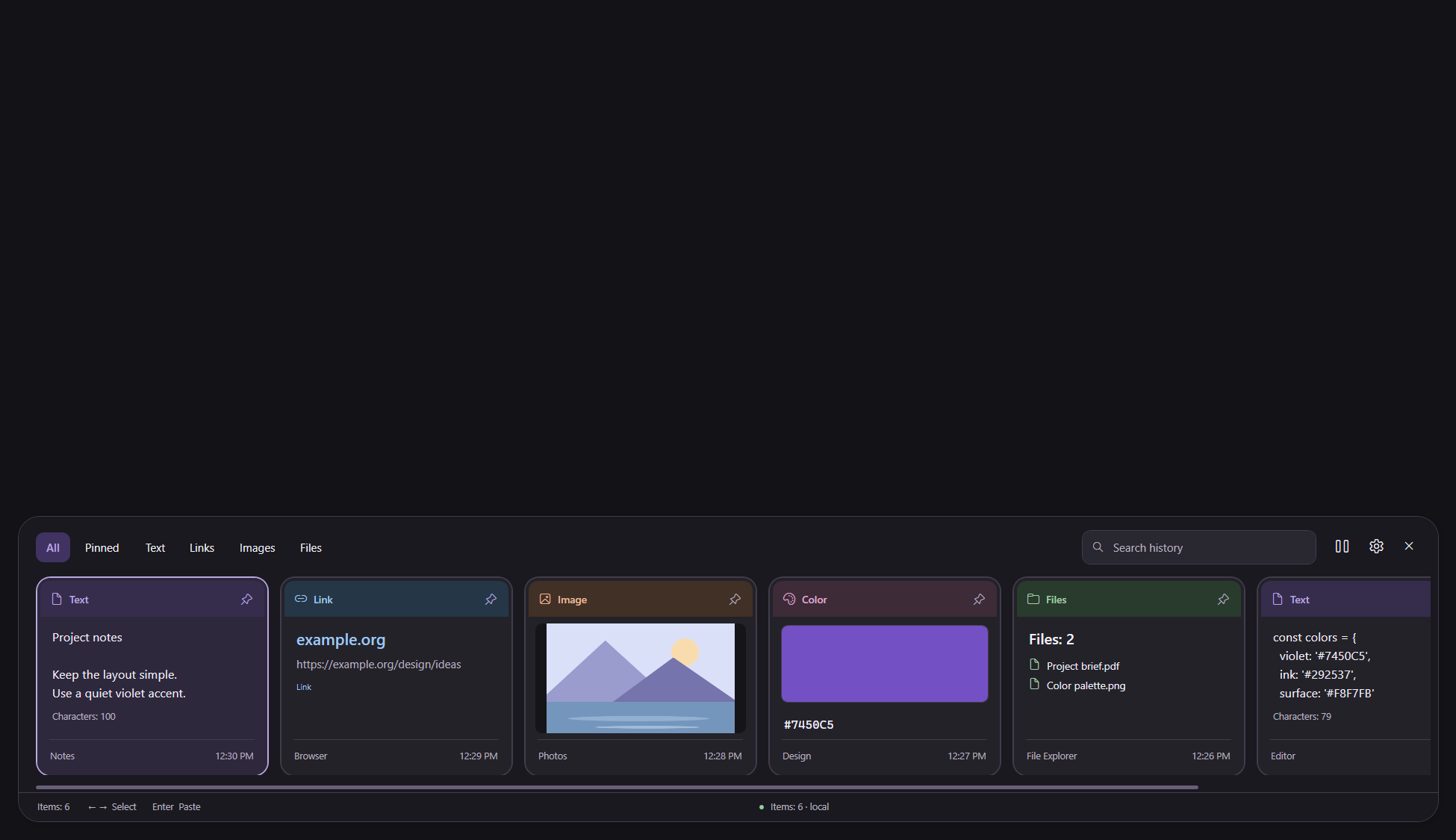
Text, links, images, colors, and files in a visual ribbon.
The ribbon is the center of the experience. It keeps recent copies in view without turning a quick paste into a separate workspace. Search narrows the history, filters separate different kinds of content, and pins keep useful items close.
The details mattered to me: keyboard navigation, light and dark themes, a quiet violet accent, and two short sounds for copying and pasting. Vstavka also supports 24 interface languages.
History stays on the computer, protected for the current Windows user. There is no app account or cloud sync. Pause, application exclusions, and retention settings let the user decide what to keep. Text is stored without formatting; file cards remember paths rather than making backup copies of the files.
One afternoon, end to end
I described a clipboard app for Windows: a horizontal ribbon, a shortcut, and a pleasant way to find things again.
A concrete product directionThe first implementation session started on 6 September 2026 at 11:54 UTC. By 12:28, there was an installed preview to try. That first step took about 33 minutes.
The rest of the afternoon was product work: trying the app, refining the layout and localization, correcting behavior, and improving the feel of the animation. I could react to a running application instead of imagining a specification.
By 15:52 UTC, the first version had been submitted to Microsoft Store. A brief, a working app, and a Store submission in one afternoon. By 7 September, Vstavka was available to download.
I directed. Astra implemented.
The idea.
The direction.
The feedback.
The implementation.
The iterations.
The submission.
My part was the idea, product choices, feedback, and decisions that needed an owner. Astra turned that direction into the application: implementation, debugging, build work, packaging, and the steps needed to submit it to the Store.
Zero lines written by me. A real application, with code underneath it.
The result is a native Windows application built with C#, .NET, and WPF. “No code” describes my side of the process. There was still code to write, behavior to check, and a release to prepare. I delegated that work through a conversation.
That changed where I spent my attention. I was choosing how the product should behave and responding to what I could see. A request became a working version; feedback became the next iteration.
Shipping was part of the job
I also wanted the process to reach the Store. Astra handled the delivery workflow: the package, listing material, screenshots, and submission. I made the owner decisions and gave the approvals; the agent carried out the release work too.
After Microsoft's certification, Vstavka became available on the Store, published by Horoko. The app was something another person could install from a link.
For me, that is the interesting part of this experiment. In one day, I went from describing a small tool I wanted to having it built and submitted. The work reached a place where someone else could discover it and use it.
Try it for yourself
Vstavka is free on the Microsoft Store. Install it on Windows 11 x64, enable history, and press Ctrl + Shift + V after copying a few things.
For feedback, a problem report, or privacy information, visit the Vstavka support repository.
The launch film brings the story together with real application screenshots, sample clipboard content, animation, and original music. It was made through AgentLane.